
The IEEE International Conference on Communications, Networks, and Satellites (COMNETSAT) 2025 was successfully held on December 6-8, 2025, in Padang, Indonesia. This event demonstrates a strong commitment to global academic collaboration, marked by extensive international participation and a strict peer review process. The conference attracted 302 members of the International Technical Program Committee (TPC) and 150 expert reviewers from 46 countries, reflecting the growing international recognition and impact of COMNETSAT among the global research community.
For COMNETSAT 2025, a total of 161 papers were submitted by authors from 28 countries. Each paper underwent a strict review process, evaluated by a minimum of three international reviewers, with an average of 3.5 reviews per paper. After careful evaluation, 96 papers were accepted, with an acceptance rate of 59.6%, demonstrating the conference’s commitment to maintaining high academic standards. Out of the accepted papers, 81 papers were officially registered for presentation at the conference
The distribution of registered papers across various conference tracks highlights the diverse and evolving research interests within the COMNETSAT community. The Data Science and Artificial Intelligence track emerged as the most prominent, with 47 papers registere, followed by Networks and IT with 13 paper, Communications with 11 papers, Satellite with 7 papers, and Broadband and Photonics with 3 papers. This distribution demonstrates the increasing relevance of intelligent data-driven approaches alongside core communication and satellite technologies.
COMNETSAT 2025 is further enriched by two distinguished keynote speakers from different countries delivering in-depth presentations. The first keynote speaker is Prof. Dr. Ing. Wahyudi Hasbi from the National Research and Innovation Agency (BRIN), Indonesia, who delivered a presentation titled “Remote Sensing and Disaster Mitigation Through Small Satellites: Tools for Sustainable Development”. His presentation highlights the strategic role of small satellite technology in supporting disaster mitigation efforts and sustainable development initiatives, especially in disaster-prone areas.
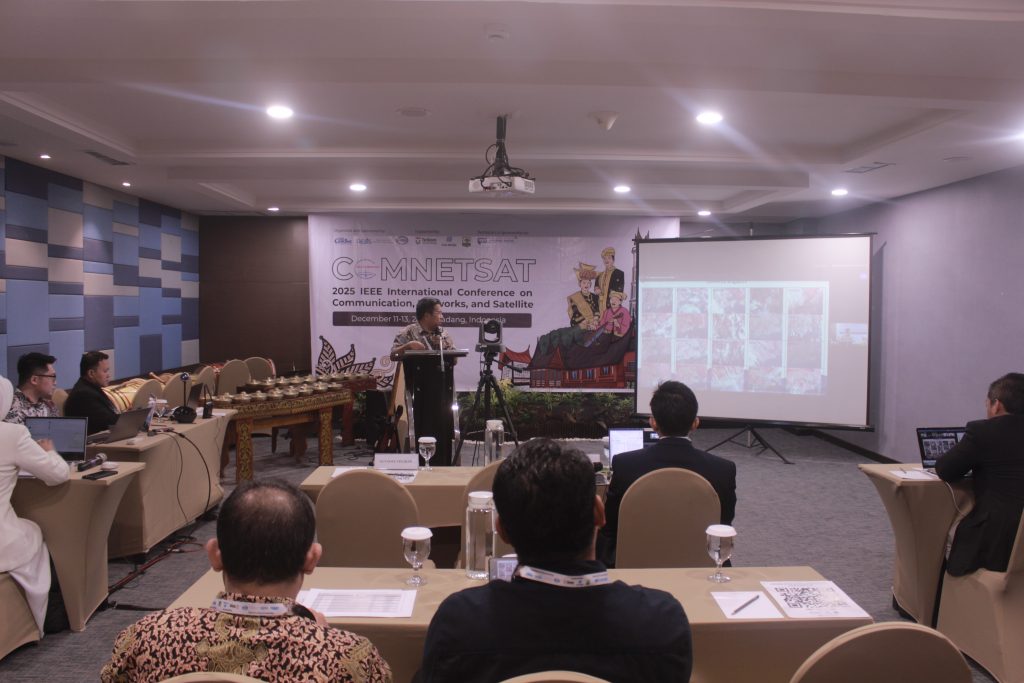
The second keynote speaker is Prof. Takaya Yamazato, Ph.D. from the Institute of Science and Liberal Arts, Nagoya University, Japan. In his presentation titled “From Image Sensor Communication to Task-Oriented Communication”, he provided visionary insights into a new communication paradigm that integrates sensors, communication, and task-oriented system design.
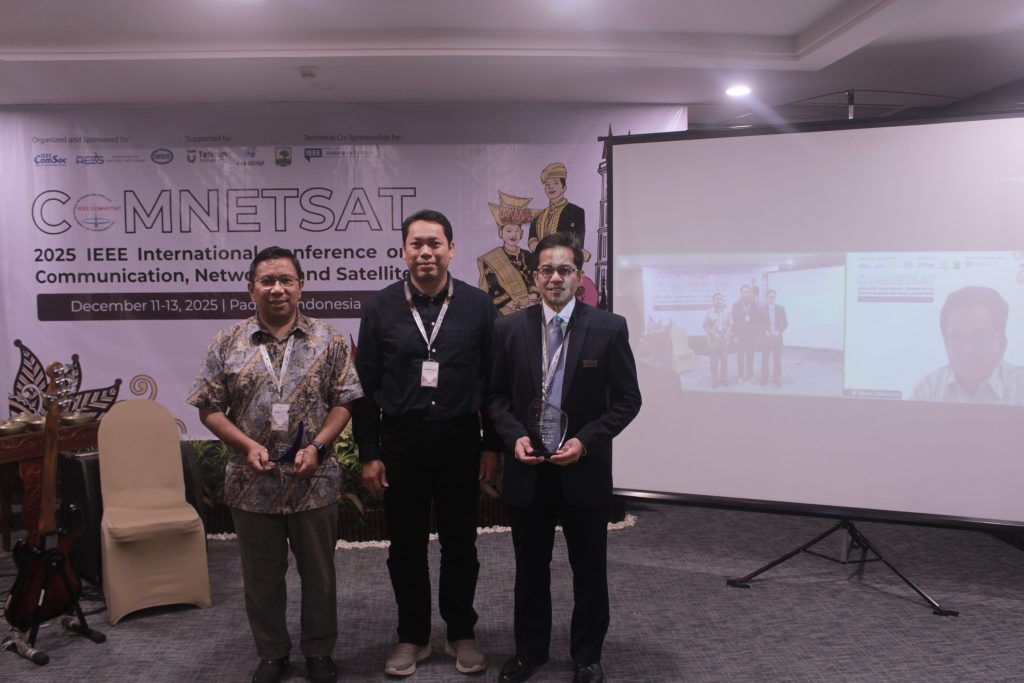
During the conference, participants actively participated in technical sessions that facilitated knowledge exchange, discussion, and collaboration among researchers, professionals, and students from around the world. The success of COMNETSAT 2025 was made possible thanks to the dedicated efforts of the international TPC members, reviewers, keynote speakers, session chairs, and organizing committee.
By facilitating high-quality academic discussions and strengthening international collaboration, COMNETSAT 2025 reinforced its role as an important international forum for promoting research and innovation in the fields of communications, networking, and satellite technology.