
The Professional Engineers Series event, organized by BKE PII and supported by the IEEE ComSoc Indonesia Chapter, was successfully held on July 25, 2026. The third installment of this series focused on the theme “Keselamatan sebagai Fondasi Keinsinyuran Berkelanjutan: dari Awareness hingga Teknologi Deteksi Kebakaran” with the aim of providing an in-depth perspective on the role of engineers in creating safe and sustainable systems for society.
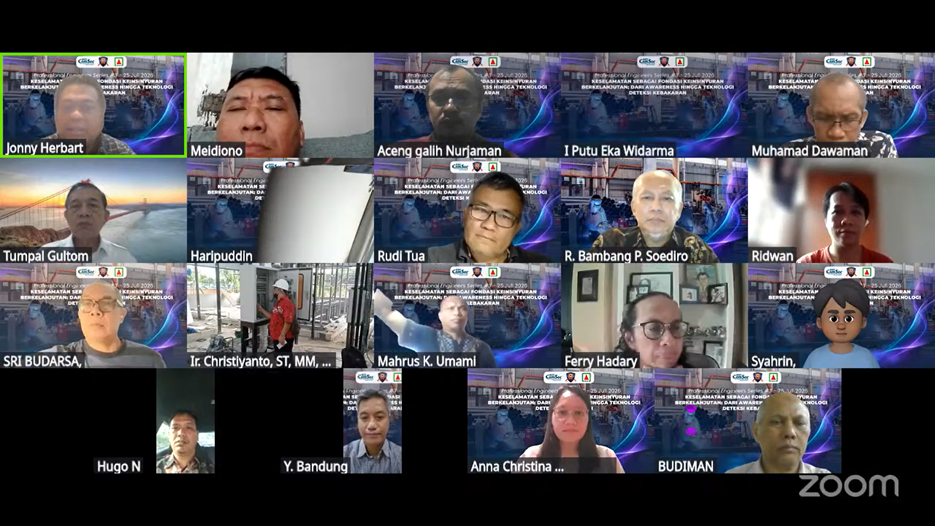
The event featured keynote speaker Ir. Tumpal Gultom, M.T., IPU, ASEAN Eng., with Ir. Jonny Herbart Sitio, S.T., IPU, ASEAN Eng., serving as moderator. The keynote speaker delivered opening remarks emphasizing that safety is not merely a procedure, but rather the cornerstone of every engineering practice. He commended interdisciplinary collaboration aimed at improving safety standards in Indonesia.
This third webinar in the series featured four expert speakers: Ir. R. Bambang P. Soediro, S.T., M.T., MKN, IPU, CCBT, CPL, ASEAN Eng., ACPE, APEC Eng., presenting on “Keberlanjutan dalam Perspektif Keinsinyuran Indonesia dari K3L menuju K5L”; Hugo Nainggolan, S.T., M.K.K.K., presenting on “Awareness K3 untuk Insinyur”; Ir. Aceng Galih Nurjaman, S.T., M.T., presenting on “Sistem Pendeteksi Kebakaran Gedung Green House Display BRIN Cibinong Tahun 2021–2022”; and Muhamad Dawaman, S.E., M.K.K.K., presenting on “K3 Kebakaran.”
Ir. R. Bambang P. Soediro, M.T., explained the paradigm shift from K3L (Safety, Health, and Environment) to K5L, as mandated by Law No. 11/2014. K5L encompasses safety, health, public welfare, community well-being, and environmental sustainability. He emphasized that future engineers must think far ahead for the sake of the Earth’s sustainability.
Hugo Nainggolan, S.T., M.K.K.K., stressed the importance of safety awareness among engineers as a preventive measure against workplace accidents, citing case studies such as the Chernobyl disaster and recent industrial incidents in Batam.
Ir. Aceng Galih Nurzaman, S.T., M.T., presented the implementation of fire detection systems in specialized buildings with the structural challenges of high ceilings and open designs, emphasizing the importance of selecting the appropriate detection technology.
Muhamad Dawaman highlighted the importance of multidisciplinary collaboration among architects, civil, mechanical, and electrical engineers in fire protection design. He emphasized that fires often occur due to risk management failures and a lack of integration between systems.
The Q&A session was enthusiastically followed by the participants. They asked about the integration of fire detection with BIM (Building Information Modeling), and Mr. Aceng explained that systems such as CCTV can be integrated with fire detection to provide real-time visualization when an incident occurs. In addition, a question regarding the risk of technicians bypassing the system was addressed by Mr. Dawaman, who explained that bypasses must be included in the company’s risk assessment (HIRADC) to ensure they remain procedurally controlled. The participant also voiced concerns regarding engineering competency regulations, which currently do not require an engineering degree to sign off on technical documents. Mr. Bambang acknowledged this challenge and urged the PII to be more active in ensuring compliance with engineering laws.
Through this webinar, it can be concluded that sustainable engineering requires integrity, regulatory compliance, and interdisciplinary collaboration. The transformation toward K5L is crucial for Indonesian engineers to ensure the nation’s welfare and long-term environmental sustainability.