
BKE PII, in collaboration with the IEEE ComSoc Indonesia Chapter, successfully hosted the second Professional Engineers Series on June 27, 2026. The theme for this event was “Rekayasa Sistem Cerdas Berbasis Data: Dari Internet of Video Things, Monitoring Spektrum Bergerak, hingga Edge Computing untuk Otomasi Industri” Moderated by Dr. Ir. Anna Christina Situmorang, A.Md., S.T., M.T., IPU, ASEAN Eng., APEC Eng., this webinar provided an opportunity for engineers, professionals, academics, and stakeholders to address the challenges of digital transformation and data-driven industries.
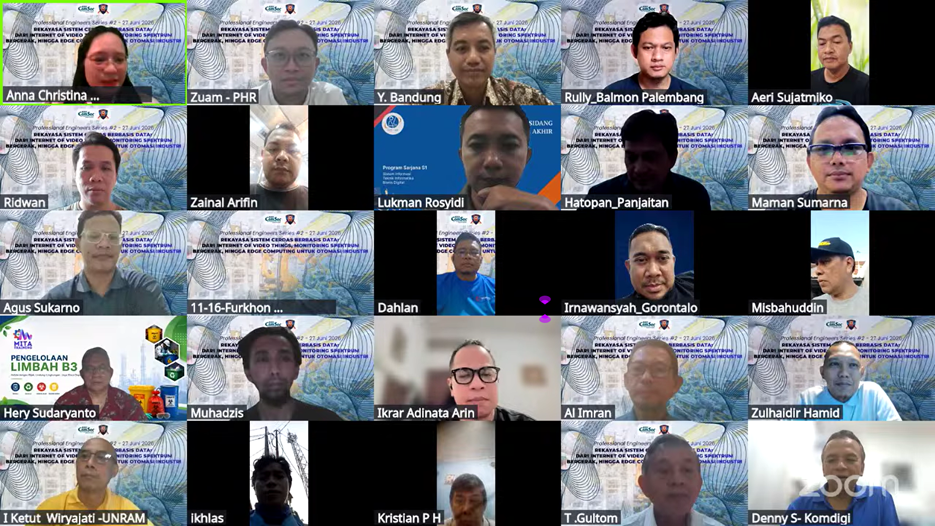
The event featured keynote speaker Ir. Tumpal Gultom, M.T., IPU, ASEAN Eng., APEC Eng., who opened the event by emphasizing the crucial role of data-driven intelligent systems engineering in supporting industrial transformation and enhancing the professionalism of engineers in Indonesia. He also expressed his gratitude and appreciation to the speakers for their willingness to share their knowledge.
The first speaker was Prof. Dr. Ir. Y. Bandung, S.T., M.T., who presented on “Rekayasa Sistem Pengiriman Video Adaptif pada Internet of Video Things (IOVT)”. He explained the evolution of video technology, which has become the primary data source for smart systems. He also presented a system design capable of adapting to network throughput fluctuations in real time using the Simple Exponential Smoothing (SES) statistical method to maintain Quality of Experience (QoE).
The second speaker was Ir. Zulhaidir Hamid, S.T., M.G.ICT.Pol., who presented on “IoT-SDR Monitoring & DRaGon Deep Learning Geolocation.” He discussed the transformation of the radio frequency spectrum monitoring system in Indonesia. This innovation utilizes Software-Defined Radio (SDR) and Deep Learning (CNN) technologies to automate signal detection and geolocation of transmission sources, which is crucial for the efficient use of the spectrum as a national asset.
The third speaker was Ir. Zuam El Bachron Achmad, S.T., who presented on “Edge Computing Value Creation for Beam Well Artificial Lift by Capturing Well Dynamic Conditions Using High-Frequency Data and Autonomous Control at the DX Field.” He discussed the implementation of edge computing in the Beam Well Artificial Lift system at the DX oil field. The use of edge computing enables high-frequency data processing directly at the source for autonomous decision-making, thereby creating added value for operational efficiency and equipment reliability.
| | |
The Q&A session was actively participated in by attendees from diverse backgrounds. They asked questions regarding the key competencies Indonesian engineers need to design and develop data-driven intelligent systems that are secure, reliable, and provide added value. The speakers emphasized the importance of multidisciplinary integration, networking skills, an understanding of on-site operations, and a strong determination to continue learning. Additionally, Prof. Bandung and Ir. Zulhaidir addressed questions regarding the realization of the Internet of Video Things (IoVT) through technological innovations such as improved data compression, real-time resolution adaptation, the use of MIMO antennas, and spectrum optimization. Mr. Adis Alifiawan, Director of Radio Frequency Spectrum Management at Komdigi, asked about the potential role of AI in replacing or displacing human staff in frequency monitoring at the Komdigi Monitoring Center (UPT) over the next five years. Ir. Zulhaidir Hamid responded that AI and deep learning will serve as tools, and the focus will shift from merely operating measuring instruments to acting as data analysts who function as “humans-in-the-loop” to provide feedback to AI models.
This webinar provided a broader understanding of modern intelligent systems that require multidisciplinary integration among sensors, networks, computing, and artificial intelligence. Future engineers are expected to continue learning, adapt to new technologies, and understand operational needs in the field to develop systems that are safe, reliable, and add value.